
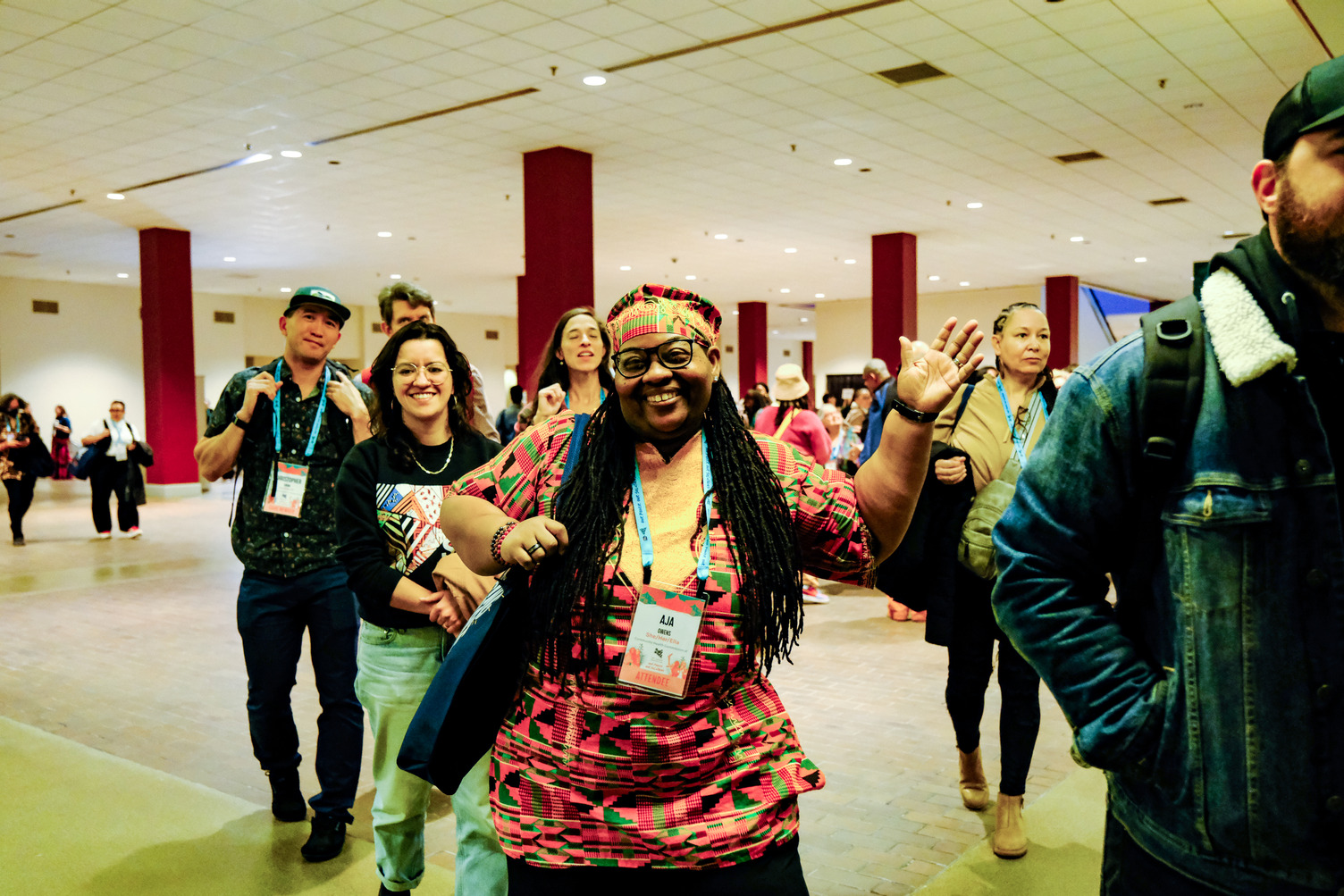
This week, thousands of organizers, artists, thinkers, and movement-builders will gather in Raleigh, North Carolina, for Facing Race 2026. As the calendar turns and the date draws near, I find myself pausing in the quiet moments of my days, feeling that distinct, familiar pull that always precedes a national gathering. If you have spent any time in movement work, you know the feeling well: a potent mix of quiet exhaustion, electric anticipation, and deep, grounding hope.
In a world that constantly demands we move too fast, react too quickly, and process profound injustice in isolation, the simple act of coming together in physical space feels revolutionary. Facing Race has long served as both a sanctuary and a forge: a dedicated space to nourish our spirits, sharpen our strategies, and reconnect with our shared humanity. But as we prepare to land in Raleigh this year, the call feels particularly urgent. We are not merely gathering for a conference; we are stepping onto historical ground to claim our collective future.
When people ask me why I stay committed to advocacy, especially during seasons when progress feels painfully slow or actively under siege, my answer always comes back to something simple: Advocacy is how we love each other in public.
It is easy to let the word "advocacy" become sanitized, stripped of its soul and relegated to formal policy briefs, legislative lobbying, or corporate compliance checklists. But at its core, advocacy is deeply human and intensely personal. It is the refusal to accept systemic harm as inevitable. It is the conscious decision to raise your voice not only for your own survival, but for the dignity, safety, and joy of your neighbor. Advocacy is a quiet, daily promise: I see what is happening, I care, and I will not look away.
In my own journey, advocacy hasn't always looked like standing behind a microphone or leading a march. More often, it has looked like staying late after community meetings to listen, holding space for someone’s grief, demanding accountability from institutions that would prefer silence. It is an enduring commitment to transformation.
Advocacy reminds us that the systems weighing on our communities were built by human hands, which means they can be dismantled and reimagined by human hands, too. Showing up to advocate is our way of asserting that our liberation is non-negotiable.
There is a persistent myth that movement history is written by isolated heroes, lone individuals who stood up and single-handedly altered the course of history. But anyone who has ever organized a neighborhood, a workplace, or a coalition knows that real, lasting power is never a solo act. True transformation relies on collective agency.
This year’s conference theme—Rooted in Resistance, Powered by Solidarity—gets straight to the heart of what this moment demands. Resistance is our bedrock; it is the firm line we draw against injustice. But solidarity is the engine that moves us forward. Resistance says no to oppression, while solidarity says yes to each other.
Collective agency is the understanding that while one voice can be drowned out, a chorus cannot be ignored. When we step out of our individual silos and bring together our unique experiences across race, generation, discipline, and geography, something sacred happens. We begin to see that our struggles are interconnected, and so are our solutions.
Solidarity asks us to move beyond passive empathy into active partnership. It requires us to show up for issues that might not affect us directly today, knowing that none of us are truly free until all of us are. In a culture that relentlessly promotes hyper-individualism and self-reliance, choosing to stand, plan, and act collectively is itself a radical act of resistance. It is how we build power that lasts long after the conference lights go down.
Gathering in Raleigh, North Carolina, carries a weight and a beauty that cannot be overstated. The American South has often been unfairly flattened in the public imagination, reduced to a monolith of historical trauma or political gridlock. But those who know movement history know the truth: North Carolina has long been a fertile, fiery landscape for social change.
To walk through North Carolina is to walk on soil soaked in the legacy of movement giants. Just down the road in Greensboro, four young Black college students sat down at a Woolworth’s lunch counter in 1960, igniting a youth-led sit-in movement that transformed the nation. Right here in Raleigh, at Shaw University, the legendary organizer Ella Baker helped launch the Student Nonviolent Coordinating Committee (SNCC), trusting in the power of young people and cultivating grassroots leadership from the bottom up. Decades later, North Carolina gave rise to the Moral Monday movement, demonstrating to the entire country how broad-based, interfaith, multiracial coalitions can rise together against regressive politics.
North Carolina reminds us that the South is not a region to be written off, but a place of deep imagination, strategic brilliance, and unstoppable movement-building. When we gather in Raleigh this week, we step into this lineage. We draw strength from the elders who organized these streets, and we listen closely to the local North Carolina leaders who are actively shaping the future of racial justice today. The roots here run deep, and they are pushing up new growth every single day.
As I pack my bags and prepare my heart for Facing Race 2026, I am holding space for everything this gathering promises to be. I am ready for the rigorous conversations, the strategic debates, and the unlearning. But just as importantly, I am ready for the joy. I am ready for the hallway laughter, the shared meals, the music, and the warm embraces of comrades who understand the weight of the work without needing an explanation.
We do not gather in Raleigh to escape the world’s heavy realities; we gather so we can face them together with clearer vision and renewed fire. If you are joining us in Raleigh this week, bring your full self—your victories, your questions, your fatigue, and your hope.
We are part of a long, unbroken chain of people who believed a more just world was possible and were brave enough to build it together. I’ll see you in Raleigh. Let’s get to work.
About the author
Hadassah Evans (she/her/hers) is a third-year, pre-law undergraduate student at Wake Forest University pursuing a double major in Sociology with a concentration in Crime and Criminal Justice and African American Studies. A proud North Carolinian, Evans strives to bridge the gap between systemic legal frameworks and marginalized communities through actionable advocacy and strategic storytelling.